

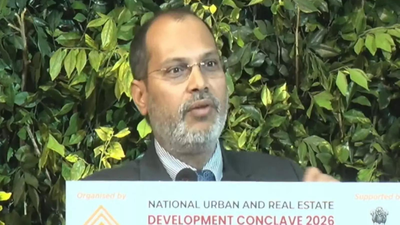
India’s real estate regulatory framework must move towards artificial intelligence-led oversight and machine-to-machine digital integration as the country prepares for rapid urban expansion, a senior Union housing ministry official said on Saturday.Addressing the National Urban & Real Estate Development Conclave organised by NAREDCO at the Yashobhoomi Convention Centre, Kuldip Narayan, joint secretary in the ministry of housing and urban affairs (MoHUA), said India’s urban population is projected to rise from around 50 crore currently to nearly 80 crore by 2047-2050.“Whether we like it or not, our urban population will cross 80 crore by 2050. We have to adapt, and we have to carefully align our actions,” he said, noting that more than half of the built-up space required by 2050 is yet to be constructed, reported ANI.Over the next two to three decades, India will need to expand housing supply significantly while undertaking large-scale brownfield redevelopment. However, housing cannot be viewed in isolation. “Talking about them separately is an urban policy error,” he said, referring to the need to integrate housing, urban planning and public transport.Narayan flagged land market inefficiencies as a key constraint. A substantial portion of urban land remains locked due to regulatory hurdles and litigation, with land accounting for over 50% of total project cost in several cities. “We need efficient land markets and a strong institutional regulatory framework that promotes development rather than merely controls it,” he said.He also stressed the need for long-term capital to fund housing and infrastructure. “If we want to achieve Viksit Bharat by 2047, urban development and real estate must be structurally prepared. Society, government and the industry must move together,” he said.On regulation, Narayan said the Real Estate Regulation and Development Act (RERA) was a landmark reform but now requires deeper digital integration. Much of the data remains static and PDF-based, limiting usability. He called for machine-readable quarterly progress reports and integration of approvals, financial disclosures and compliance data to enable automated early-warning systems.Regulatory platforms, he said, should adopt machine-to-machine communication similar to banking and taxation systems, with interoperability across state RERAs to track developer activity across jurisdictions. Project-level data must also be presented in a simplified format to help homebuyers assess risks before purchase.The two-day conclave was attended by Union housing minister Manohar Lal Khattar, civil aviation minister Kinjarapu Ram Mohan Naidu, minister of state for housing Tokhan Sahu and RERA chiefs from several states.(With inputs from ANI)