

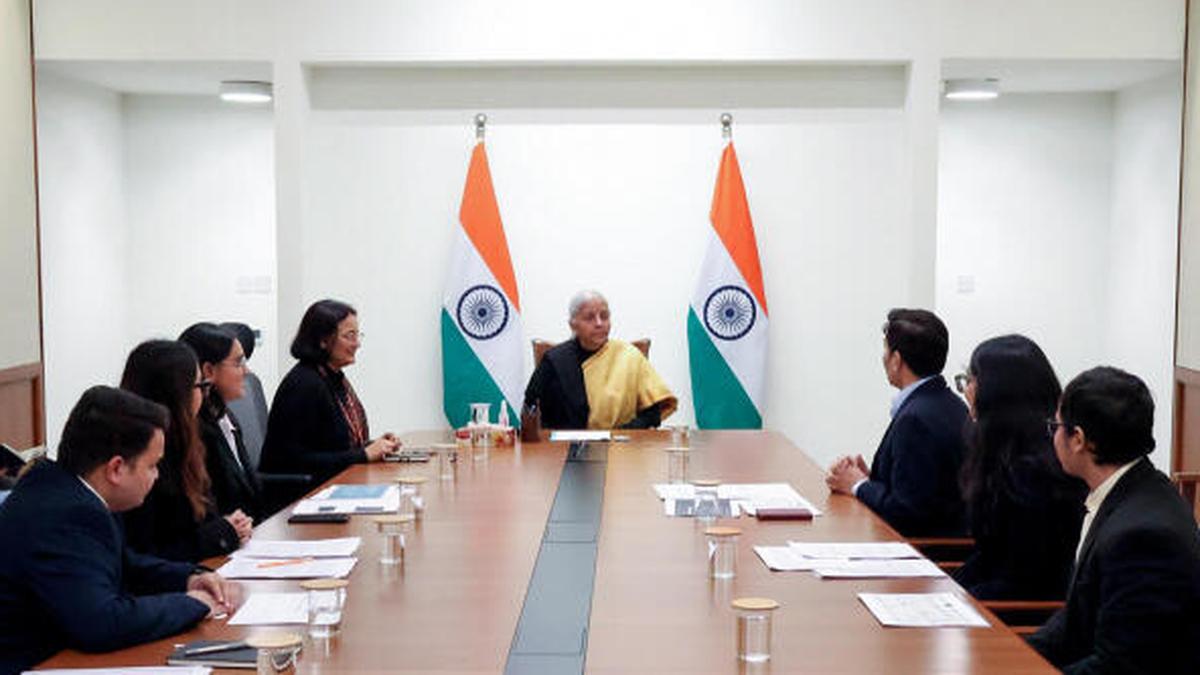
Budget documents show the allocation for the Union Education Ministry in FY 2026-27 has risen to about ₹1.39 lakh crore, an increase of 14.21% compared with the revised estimates for the current fiscal, with a majority of this increase being reflected in the allocation for the Department of School Education and Literacy, where the allocation for Atal Tinkering Labs saw a jump of ₹2,700 crore from ₹500 crore last year to ₹3,200 crore this year.
No significant budgetary commitments have, however, been made to address core problems of mainstream higher education such as colleges and universities even as the government wants to achieve 50% GER in colleges. At the same breath, the Economic Survey predicts creative destruction in higher education. It says: “With the evolving modes of content delivery, traditional HEIs now compete with edtech platforms also.

As the quality of content and delivery becomes the primary metric of performance, it also becomes the measure for performance-linked funding, shifting the traditional institution-centric funding to learner-centric support, where learners are directly funded and have the choice of content providers. These developments blur ownership, location, legacy reputation, and other factors. Does this mean the government has given up on committing itself to a major revamp of the primary and higher education system committed to an aware, educated, skilled and productive population?
To decode the 2026 education budget, The Hindu will host a webinar titled, ‘Budget: Consequences for education?’, on February 7, 2026 at 5:00 p.m. The panellists include: Saumen Chattopadhyay, Professor, Jawaharlal Nehru University, New Delhi; Abhishek Malhotra, Assistant Professor, Sri Venkateswara College(DU); and Jones Mathew, Principal & Head of Institution Great Lakes Institute of Management Gurgaon. The webinar will be moderated by M. Kalyanaraman, who heads the education vertical at The Hindu.

Register now for free to ask questions and interact with the panellists. The three best questions will receive a free online subscription to The Hindu.
Panellists
Saumen Chattopadhyay, Professor, Jawaharlal Nehru University, New Delhi
Saumen Chattopadhyay has been a professor at the Zakir Husain Centre for Educational Studies (ZHCES), Jawaharlal Nehru University (JNU) since 2010. Earlier, he worked at the National Institute of Public Finance and Policy (NIPFP) during 1995-2004. He did his Ph.D on the black economy in India from Centre for Economic Studies and Planning (CESP), JNU in 2002. His research areas include Economics of Education focusing on policy making in higher education, financing and regulation of higher education, and macroeconomics of the black economy in the context of India.
Abhishek Malhotra, Assistant Professor, Sri Venkateswara College(DU)
Abhishek Malhotra is an Assistant Professor of Economics at Sri Venkateswara College, University of Delhi and is a Visiting Fellow at India Foundation. He holds a Ph.D. in Economics and specializes in the field of Urban Economics and Economic Policy. He served as Secretary (Partnerships and Finance) at the Y20 India Secretariat during India’s G20 Presidency. He has also worked with the office of Chief Economic Adviser at the Ministry of Finance, Gol. and as a research associate with IIM Ahmedabad.
Jones Mathew, Principal & Head of Institution Great Lakes Institute of Management Gurgaon
Jones Mathew brings a combination of 18 years of corporate experience with Indian and multinational companies and 15 years of academic leadership. With expertise in Marketing, Brand Strategy, and Consumer Behaviour, he has led high-impact industry initiatives before moving into academia. He holds a Ph.D. from the Indian Institute of Foreign Trade (IIFT) and an MBA in Marketing. At Great Lakes Institute of Management, he also leads institutional accreditation and ranking initiatives, including NBA, AMBA, AACSB, and NIRF.
(For any feedback or suggestions, reach out to us at education@thehindu.co.in)